Here’s the number that should change how you shop for a blood pressure monitor: when researchers checked 100 of the best-selling BP devices on Amazon, 81% had never undergone proper validation testing. The gadget aisle is full of confident-looking cuffs that have never proven they can measure anything.
So this 2026 update of our sphygmomanometer guide is built around one filter — validatebp.org, the AMA-backed registry of devices that actually passed accuracy testing — and one structural truth: nurses need two different instruments. A manual aneroid cuff for school checklists and clinical skills (yes, programs still require manual BP in 2026 — it’s on the supply lists), and a validated automatic monitor to recommend to patients and family.
Best Blood Pressure Monitors and Sphygmomanometers in 2026
- For your clinicals (manual): ADC Prosphyg 760 · ADC Diagnostix 703 · Welch Allyn DS44
- For your patients (validated automatic): Omron Platinum · Omron Silver · Withings BPM Connect · A&D UA-651BLE
ADC Prosphyg 760 – Best Manual Cuff for Nursing School
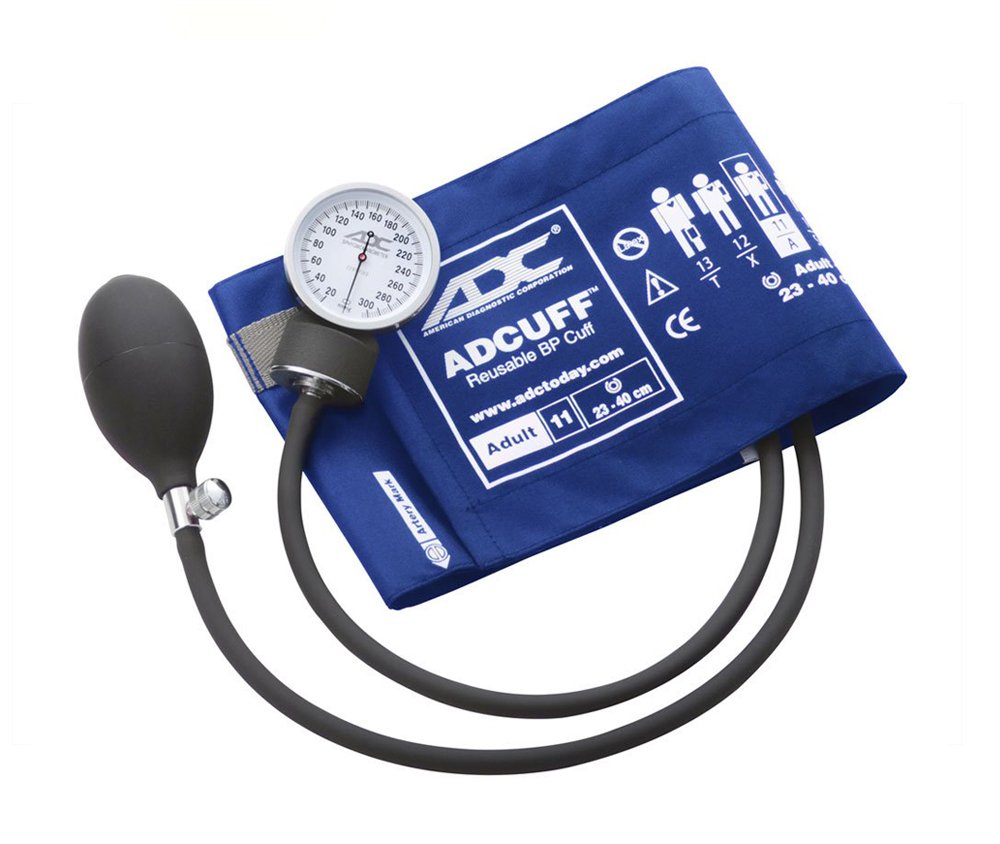
The classic nursing-student sphyg, and still the right first buy: around $30-45 gets ADC’s pocket aneroid with a gauge the company describes as its institutions’ model of choice, an adult cuff covering 23-40cm arms, and — the underrated part — a 20-year calibration warranty. It’ll survive being crammed into a clinical bag for years past graduation.
Pair it with your stethoscope, learn Korotkoff sounds properly, and pass the skills checkoff. That’s its whole job, and it does it at student prices.
- The skills-lab standard at ~$30-45
- 20-year calibration warranty
- Compact, bag-friendly
- Two-tube design takes practice to manage
- Buy extra cuff sizes separately
ADC Diagnostix 703 – Best One-Hand Palm Aneroid
The 703 is the manual cuff you graduate to: a palm-style gauge that sits in your hand with a trigger air release, so cuff, gauge and deflation control all work one-handed while your other hand holds the stethoscope. Its Japanese-made movement is rated for 50,000 inflation cycles — this is the sphyg EMS crews and home-health nurses carry daily.
At $80-120 it costs three times the Prosphyg and earns it in ergonomics and durability. If manual pressures are part of your daily work rather than a school requirement, spend up.
- True one-hand operation
- 50,000-cycle tested movement
- Field-work favorite
- $80-120
- Overkill for skills-lab-only use
Welch Allyn DuraShock DS44 – Most Durable Gauge
Welch Allyn (now part of Baxter, still very much in production) solved the aneroid gauge’s oldest weakness — drop it and it drifts out of calibration — with the gear-free DuraShock movement. The DS44 mounts the gauge right on the cuff, shrugs off the knocks that kill ordinary gauges, and sells for a reasonable $45-60.
It’s the hospital-brand manual option: the name your clinical instructors trained on, engineering that survives the reality of a working bag, priced between the two ADCs.
- Shock-resistant gear-free movement
- Cuff-mounted gauge — nothing dangling
- Hospital-brand pedigree
- Cuff sizes sold separately
- Brand ownership changes confuse listings
Omron Platinum – Best Automatic BP Monitor
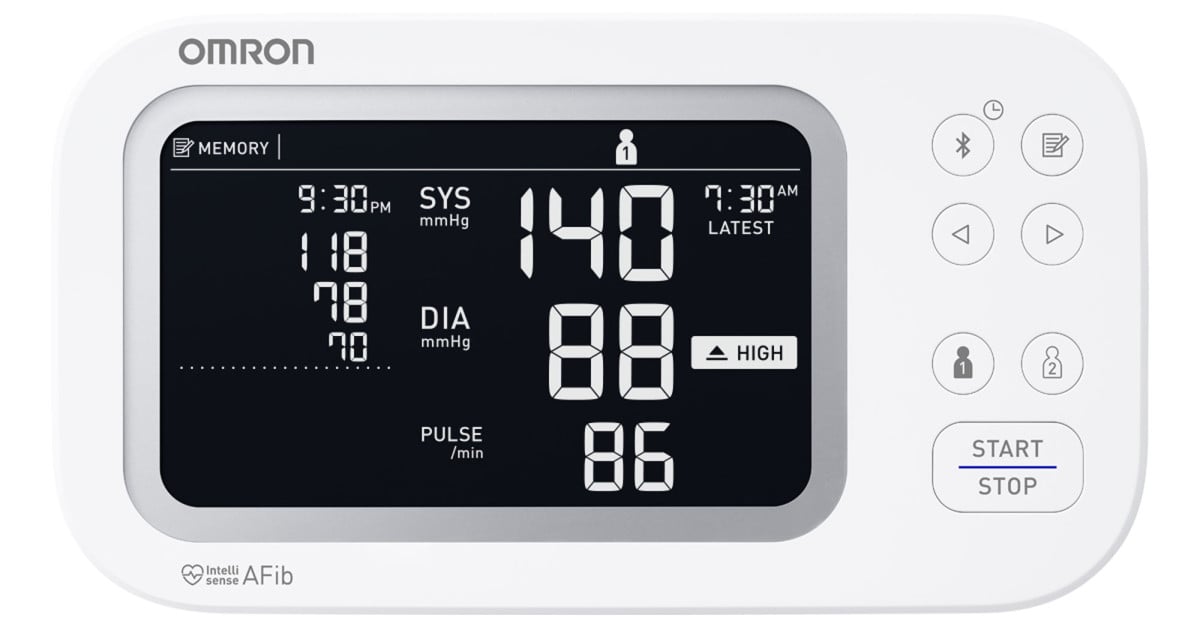
When a patient asks “which one should I buy?”, Omron’s flagship is the safest name to say. Clinically validated (it’s on the validatebp.org registry), top accuracy marks in independent lab testing, a wide-range cuff that fits 9-17″ arms, two users with cloud backup via the app, three-reading averaging, and — on the current BP5465 version — AFib screening with every measurement. Typically $75-90.
For a hypertensive patient doing serious home monitoring — the kind whose readings you’ll actually chart from — this is the recommendation that won’t bounce back at you.
- Clinically validated (validatebp.org)
- Wide-range cuff fits larger arms
- AFib screening, 2 users, app history
- Pricier than the Silver below
- App setup defeats some elderly users — help them once
Omron Silver BP5250 – Best Value Validated Monitor
Same validation registry, same 9-17″ easy-wrap cuff, same Bluetooth app with unlimited cloud readings — for around $50-70. What the Silver drops versus the Platinum is the second user, the dual display and the multi-reading averaging; what it keeps is everything that makes the reading trustworthy, including irregular-heartbeat and movement-error detection.
This is the one to name when budget matters and the patient monitors for one person. It’s the sweet spot of the whole automatic market.
- Validated accuracy at a $50-70 price
- Movement and irregular-heartbeat flags
- Unlimited history in the app
- Single user profile
- Only 30 readings on the device itself
Withings BPM Connect – Best for Technophobe Patients
The Withings solves the problem every nurse who’s set up a parent’s BP monitor knows: the phone. It syncs over Wi-Fi by itself — no app open, no Bluetooth pairing dance — and shows the reading on its own LED display. FDA-cleared, on the validated list (including for pregnant patients), one-piece design with no tubes, about $130.
Family members see every reading arrive remotely — which for adult children monitoring aging parents is the entire value proposition. Caveat to mention: some advanced app features push toward a subscription; the core measuring and syncing don’t need it.
- Wi-Fi sync — no phone needed at reading time
- Validated, incl. pregnancy population
- Remote family monitoring built in
- ~$130
- Subscription creep in the app extras
A&D Medical UA-651BLE – The Quiet Professional’s Pick
A&D is the validated-device manufacturer nobody advertises and every BP nerd respects — the Mayo Clinic’s own store carries this model, which says more than a marketing budget. Around $50-70 buys Bluetooth, a 22-42cm cuff, averaging, irregular-heartbeat detection, and an unusually generous five-year monitor warranty.
Functionally it trades blows with the Omron Silver; pick whichever is cheaper the day you look, and either way the patient gets a validated instrument.
- Validated; sold by the Mayo Clinic store
- 5-year warranty
- FSA/HSA eligible
- Plainer app than Omron’s
- Less retail visibility — stock varies
How to Choose (and What to Tell Patients)
Check validatebp.org before any purchase. That’s the single filter that removes the 81% problem. If a monitor isn’t on the list, its five-star reviews are measuring vibes.
Cuff size beats features. A too-small cuff reads falsely high — the most common home-monitoring error. Measure the arm; larger patients need the wide-range cuffs (both Omrons above go to 17″) or a dedicated large cuff.
And yes, keep your manual skills. Automatic monitors mislead exactly where nursing gets interesting — arrhythmias, hypotension, tremor. That’s why the skills checklist still exists, and why a $35 aneroid cuff belongs in every nurse’s bag next to the stethoscope.
Conclusion
- Nursing school: ADC Prosphyg 760. Daily field work: ADC 703 or Welch Allyn DS44.
- Patient recommendation, no caveats: Omron Platinum; on a budget, Omron Silver or A&D UA-651BLE.
- For the relative who can’t work a smartphone: Withings BPM Connect.