Here’s the distinction that untangles the whole insole question: cushioning and support are different jobs. Your Hoka’s marshmallow midsole absorbs impact brilliantly — but its factory liner is a flat foam pad that does nothing to hold a collapsing arch. That’s why podiatrists writing for nurses keep recommending a specific combination: max-cushion shoe plus structured insole. And it’s also why a neutral-footed nurse with happy feet doesn’t need this article at all.
For everyone else — plantar fasciitis sufferers, flat feet, high arches, the “my arches die by hour nine” crowd — here are the 2026 picks, chosen with actual podiatry sources rather than marketing.
The Best Insoles for Nurses in 2026
- PowerStep Pinnacle — Best Overall / Plantar Fasciitis
- Superfeet Green — Best for High Arches
- Currex RunPro — Best for Hoka & Brooks
- Fulton Athletic — Best Custom-Molding Cork
- Dr. Scholl’s Work — Best Budget
PowerStep Pinnacle – Best Insoles for Nurses Overall
When a podiatry practice publishes a nurses’ insole guide, the Pinnacle is the default they reach for: a firm supportive shell under a forgiving cushioned top cover, a deep heel cup, and an arch profile moderate enough to fit most shoes and most feet. It’s the standard over-the-counter answer for plantar fasciitis — supportive enough to matter, padded enough to tolerate during a flare, around $40-55.
The known combo for symptomatic nurses is literally this insole inside a Hoka Bondi. Visible overpronators (inner ankle rolling in) should take the Pinnacle Maxx variant, which adds a corrective heel post. Expect 6-12 months of life under shift mileage — the support dies invisibly before the fabric looks worn.
- The podiatrist default for standing work
- Firm support + tolerable cushioning
- Maxx variant for overpronation
- Replace every 6-12 months
- Moderate arch — extreme arches see Superfeet
Superfeet Green – Best for High Arches
The green legend: a rigid stabilizer cap and the deepest heel cup in mainstream insoles, built for high arches that collapse over a long shift. Around $60, roughly a year of life, and structure that gel simply can’t imitate.
The podiatric nuance worth relaying: that firmness is the feature and occasionally the bug — during an acute plantar-fasciitis flare, Superfeet’s hard cap can feel punishing where the PowerStep forgives. Match it to your arch (Superfeet’s color system runs from low to high volume) and it rewards; guess wrong and it lectures.
- Deepest heel cup, serious structure
- ~12-month lifespan
- Color system matches arch heights
- Firm — harsh during acute flares
- High-volume fit crowds slim shoes
Currex RunPro – Best Insoles for Hoka and Brooks
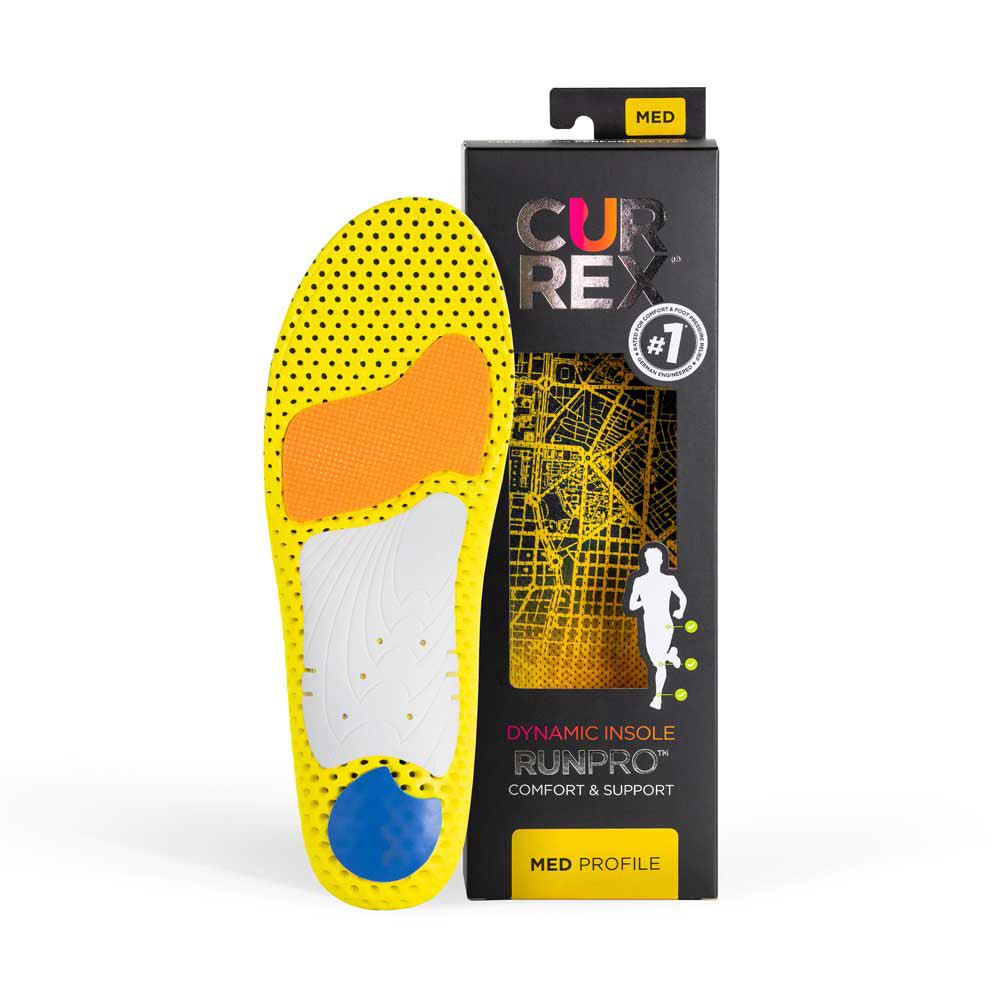
The insole problem with running shoes is volume: stuff a thick orthotic into a snug Clifton and suddenly your toes pay rent. Currex’s RunPro is the specialist answer — barely thicker than a factory liner, sold in three arch-height profiles you select to match your foot, delivering real support without re-sizing your shoe. Runners’ review sites rank it top of the running-insole category for exactly this trick.
Around $60. If your work shoes are Hokas or Brooks and the PowerStep felt like a shoehorn, this is the one designed for your situation.
- Slim profile made for running shoes
- Three arch heights — real matching
- Support without the cramped toes
- Less maximal than PowerStep/Superfeet
- $60
Fulton Athletic – Best Custom-Molding Cork
Fulton’s pitch is elegant for this audience: its cork footbed heat-molds to your foot in about ten hours of wear — in other words, one shift customizes it. Independent 2026 testing praised the deep heel cup, wider toe box and the naturally antimicrobial cork, at $50-60. The result sits between mass-produced insoles and $300 custom orthotics: shaped to your actual foot without the podiatry-office invoice.
- Molds to your foot in one shift
- Cork = supportive and antimicrobial
- Independent reviews are warm
- Break-in shift feels firm
- Newer brand, shorter track record
Dr. Scholl’s Work – Best Budget Insoles
Thirteen dollars of honest expectations: massaging gel that upgrades a flat stock liner to genuine cushioning, everywhere from Walmart to the pharmacy at midnight. What it isn’t — and this guide won’t pretend otherwise — is an orthotic: gel offers no structural arch control and compresses faster than any shell or cork above, so plan on replacing it twice as often.
Right use case: comfortable feet that just want softer shoes, budget stopgaps, and the second pair of work shoes.
- ~$13, sold everywhere
- Real cushioning upgrade over stock liners
- No structural support
- Compresses fastest — ~6-month life
Insole Rules for Shift Workers
- Remove the factory liner first — orthotics stack badly on top of it and cramp the shoe; use it as your trimming template.
- Match the arch, not the brand — a wrong-height insole is worse than none.
- Calendar the replacement — 6-12 months under full-time shifts; the foam quits silently.
- Neutral and comfortable? Skip insoles — a good max-cushion shoe alone is a complete answer for happy feet; add structure only when symptoms ask for it. Pair with compression socks and a two-shoe rotation for the full lower-limb defense.
Conclusion
- Plantar fasciitis or general ache: PowerStep Pinnacle (Maxx if you overpronate).
- High arches: Superfeet Green. Slim running shoes: Currex RunPro.
- Custom shape without custom prices: Fulton. Budget softness: Dr. Scholl’s.